Showing posts with label disease. Show all posts

Friday, 2 February 2018

Is lobster blood blue?

An interesting side-product of some of my experiments have been the varying colours of the lobster haemolymph. I remember once watching QI and there was a question about lobster (or was it crab?) blood - and the 'correct' answer was that it was blue. But is this correct? I remember shouting at the TV at the time that it was wrong (I was a misunderstood lobsterologist, after all...)

When I was doing my PhD, I uploaded a photo to twitter which people went a little crazy for. It was from the experiments I talked about in my previous blogpost and it even surprised me. Each blood sample was a different colour! All the lobsters were from a similar location (Ilfracombe, Devon), similar size (92 - 100cm in carapace length) and mostly female.  So, why, then, is there such a discrepancy... and most important of all... why aren't any blue?!!

Lobster blood samples for protein and metabolite quantification - the white bits are haemocyte pellets. Photo taken by Charlotte Eve Davies. 
First of all, let's get something straight. Lobsters don't have blood. I know I say it above and I will say it again, but as previously explained, lobsters don't really have blood. In fact, lobsters don't even have a 'closed' circulatory system like us (or mammals). Although they have a heart, which beats, and arteries, through which haemolymph (lobster 'blood') is passed through to bathe the organs, there are no veins to pass the haemolymph back to the heart. Instead, it returns to the heart via interconnecting spaces known as venous sinuses. For this reason, you will sometimes hear that the lobster's circulatory system known as an "open" circulatory system.

Okay, now that's out of the way, back to blue blood business. Some of us may have seen the (in)famous video or photos of bottles of horseshoe crab blood being decanted in a factory, for use in medical research... and we are wondering why my photo above doesn't show a similar brilliant blue hue? This is because, firstly, my samples were taken directly from a syringe, into a tube, which was closed, centrifuged and put in the freezer almost right away to stop the blood from clotting (the little white pellets you see are blood cells, or haemocytes, from the centrifugation). So the samples weren't exposed to much 'air' or namely, oxygen. 

As mentioned in one of my previous blogs, haemocyanins are the crustacean version of our haemoglobin; they are proteins that bind and transport oxygen throughout the body. Haemocyanins contain two copper atoms that bind a single oxygen molecule (remember it's O2... not O1) rather than Iron, which is what binds to oxygen in human and most mammalian bodies. Now, it's oxygenation that causes a colour change between the colourless Cu(I) deoxygenated form and the blue Cu(II) oxygenated form which is why in some cases, a nice blue colour can occur, especially when exposed to the open air - air contains oxygen which reacts with the copper present in the blood, giving us the blue colour.

However, this is not always the case. Protein levels in the blood, or haemolymph, of lobsters, and all crustaceans, are constantly changing. This can depend on the stage in the moult cycle (i.e. is it about to shed it's shell to grow?), the reproductive status (whether it is about to try and find a mate, or lay eggs) or even whether a lobster is diseased or not. It was interesting that in my photo, one sample was very dark green (bottom row, 4th from the right) - we think that this may have been due to reabsorption of eggs. There is a protein, vitellogenin which is synthesized by the ovarian tissues in lobsters. During female maturation, extra-ovarian vitellogenin is transported through the hemolymph to the ovary and is taken up into the cytoplasm oocytes, or eggs. Egg reabsorption can happen for a umber of reasons, be it adverse conditions (if the lobster is stressed), or if the egg were released too early and the lobster then needs to moult. 

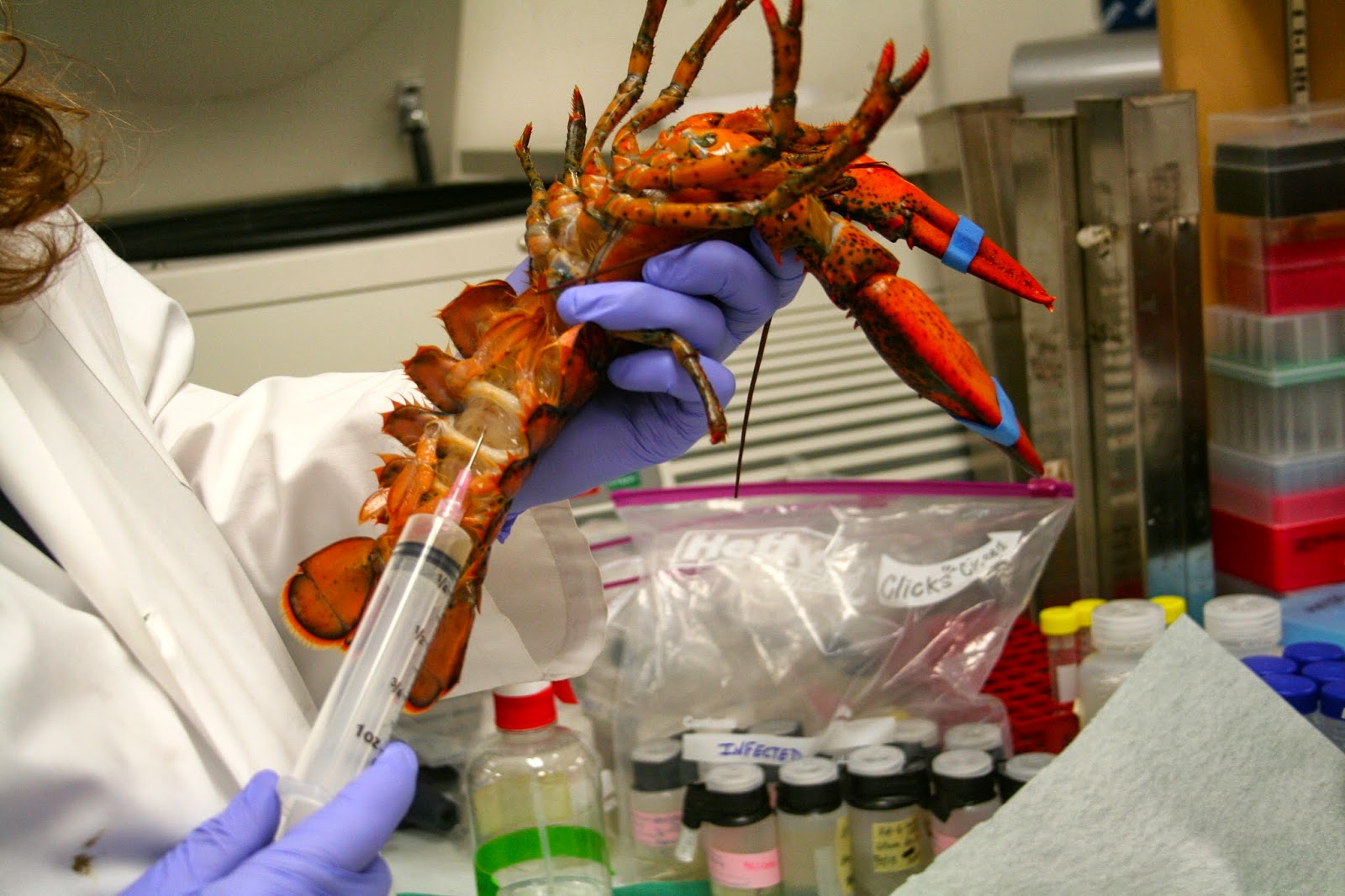
More recerntly, during my first postdoc, I have been working on a virus in the Caribbean spiny lobster Panulirus argus. The virus, Panulirus argus Virus 1 (PaV1) has some interesting effects on the haemolymph of infected hosts. It turns it a very white, milky colour, rather than the usual amber colour, due to the degradation of hemocytes (blood cells). This is how we diagnose clinically infected individuals, pulling the tail away from the body a little and looking at the almost clear membrane covering the abdomen, it can clearly be seen whether or not an animal is infected.

Diseased vs. Healthy Comparison: The lobster on the left in this shot is healthy while the one on the right is in the last stages of PaV1. During this time the hemolymph turns from clear/amber to white, as you can see in the middle syringes. Photo from http://www.pav1.org/
So that's how we know... lobster blood isn't always blue.


Tuesday, 5 April 2016

Is global warming causing marine diseases to spread?

I recently attended the Oceans Sciences Meeting 2016 in New Orleans, USA (blog to come!) to present in a session called 'Scaling Up: Marine Infectious Diseases from the Molecule to the Ecosystem'. I met a group of really cool disease-y people who recently contributed to a special issue in Philosophical Transactions of the Royal Society B; ‘Marine disease’. I decided to pitch an idea to The Conversation, a news website with 'academic rigour' with the hope of gaining more attention for the important subject of marine disease.

The article, below, was a huge success, with over 6000 hits so far and was picked up by IFLScience, Science Rocks my World and the Portland Press Herald amongst other news outlets.  The Conversation believe in the free flow of information and use a Creative Commons Attribution No Derivatives licence, so you can republish our articles for free, online or in print!

Is global warming causing marine diseases to spread?


Global climate change is altering the world’s oceans in many ways. Some impacts have received wide coverage, such as shrinking Arctic sea ice, rising sea levels and ocean warming. However, as the oceans warm, marine scientists are observing other forms of damage.

My research focuses on diseases in marine ecosystems. Humans, animals and plants are all susceptible to diseases caused by bacteria, viruses, parasites and fungi. Marine diseases, however, are an emerging field.

Infectious agents have the potential to alter ocean life in many ways. Some threaten our food security by attacking important commercial species, such as salmon. Others, such as bacteria in oysters, may directly harm human health. Still others damage valuable marine ecosystems – most notably coral reefs. To anticipate these potential problems, we need a better understanding of marine diseases and how climate change affects their emergence and spread.

Warming waters promote marine diseases


Recent studies show that for some marine species diseases are spreading and increasing. Climate change may also promote the spread of infectious agents in oceans. Notably, warming water temperatures can expand these agents' ranges and introduce diseases to areas where they were previously unknown.

Many diseases of marine species are secondary opportunist infections that take advantage when a host organism is stressed by other conditions, such as changes in pH, salinity or temperature. A bacterium that is dormant (and therefore noninfective) at a certain temperature may thrive at a slightly higher temperature.

One well-documented example is the emergence of epizootic shell disease (ESD) in American lobsters. This disease, thought to be caused by bacteria, is characterized by lesions that penetrate inward from a lobster’s shell surface towards the inner flesh, making infected lobsters unmarketable. ESD can also kill lobsters by making it difficult for them to shed their shells in order to grow.


An American lobster with epizootic shell disease (ESD). para_sight/flickr

In the 1990s, following almost a decade of above-normal summer temperatures, ESD affected so many lobsters that the Atlantic States Marine Fisheries Commission declared that the Southern New England fishery (Connecticut, Massachusetts, New York and Rhode Island) was in collapse and recommended closing it. Fishery models that incorporated shell disease offered convincing evidence that ESD was a major factor in the decline of the stock. This episode underscores the importance of considering marine diseases in stock assessments and fishery management.

Now there are concerns that ESD will continue to spread north to Maine’s US$465.9 million lobster fishery. In 2015 the Gulf of Maine showed record high abundances of lobster, making it one of the most productive fisheries in the world.

However, sea surface temperatures in the Gulf of Maine have increased faster than 99 percent of the global ocean over the past decade, warming three times faster than the global average. Since temperature is a primary factor in the spread of this disease, observers fear that it could have devastating effects on Maine’s lobster fishery.

There is also a risk that ESD could spread from American lobsters to other fisheries. Seafood wholesalers have imported live American lobsters into Europe for decades, which can result in their escape into the wild. Last summer the United Kingdom’s Marine Management Organization warned U.K. fishermen that because the European lobster shares similar habitats, food sources and diseases with the American lobster, ESD could spread between the species.

As a doctoral student at Swansea University, U.K., I collaborated with the New England Aquarium in Boston, Massachusetts to investigate this possibility. While we found that European lobsters were more likely to develop shell disease when reared in the presence of American lobsters, on the positive side, they don’t seem to get the same shell disease as American lobsters.

This means that European lobsters may be better equipped to deal with outbreaks of ESD. But with sea surface temperatures in U.K. coastal waters rising since the 1980s by around 0.2-0.9 degrees Celsius per decade, it is important to monitor U.K. waters for this disease.


European lobsters with mild, none and severe shell disease. Andrew Rowley/Swansea University

Tropical disease


Now I am now studying the Panuliris argus_1 virus (PaV1) in the Caribbean spiny lobster, where the picture is more dire. Discovered around 2000, this virus is present from the Florida Keys to Venezuela. It can infect up to 60 percent of lobsters in some areas. Laboratory studies indicate that lobsters held in high-temperature seawater and exposed to PaV1 develop active and more intense infections much more quickly than those held at lower temperatures.

Studies from 1982 to 2012 show that waters in the Caribbean are warming, with the most significant temperature increase occurring over the past 15 years – approximately the period when PaV1 appeared. If PaV1 continues to spread, it could have significant effects on the health of Caribbean reefs as a whole, as well as on the valuable Caribbean lobster fishery.

Monitoring more diseases


Many other species are also showing increasing effects from marine diseases. The frequency of coral diseases has increased significantly over the last 10 years, causing widespread mortality among reef-building coral, which are home to more than 25 percent of all marine fish species.

In the Pacific, more than 20 species of sea stars were devastated by a wasting disease that ranged from Mexico all the way up to Alaska in 2013 and 2014. Research suggests that 90 percent of some populations were wiped out, and some adult populations have been reduced to a quarter of pre-outbreak numbers.

Scientists believe the cause is a virus which becomes more active in warmer conditions. In both field surveys and laboratory experiments, starfish were found to react faster to the disease in warmer water than in cooler temperatures.


Starfish on the shore at Umpqua Lighthouse State Park - Winchester Bay, Oregon. skipplitt/flickr

As the oceans continue to warm, it is crucial to understand how our actions are affecting marine life. Some species will not be able to withstand the increase in temperature. The most recent U.S. National Climate Change Assessment projects that outbreaks of marine diseases are likely to increase in frequency and severity as waters warm under climate change. Researchers are working around the world to determine whether and how species will survive disease events in our increasingly altered oceans.

The Conversation
Charlotte Eve Davies, Postdoctoral Researcher at the Institute of Marine Sciences and Limnology, Universidad Nacional Autónoma de México (UNAM)

This article was originally published on The Conversation. Read the original article.

Sunday, 10 January 2016

Lobster blood suckers and the wonders of histology

So I promised a couple of blogs back to write a post about some of my lesser known work on parasites. If you have read some of my oldest blogposts, you will know that I entered into the world of lobster-loving through my undergraduate dissertation (or final year project, as some universities call it).

My dissertation focussed on a little known parasite Nicothöe astaci, otherwise known as the lobster louse. A parasite which lives on, and feeds on blood from, the gills of the European lobster. Now, this little critter has been documented for well over 100 years as it was first noted in 1826 by Audoin & Milne-Edwards. It has been found only on European lobsters but ranges from those inhabiting locations including Scotland, Lundy Island in the Bristol Channel and as far south  as Portugal. It has since only been written about a handful of times, and before my dissertation, the last work was over 50 years previous in 1959!

I was tasked with finding out exactly how the parasite attaches to the host, using a technique called histology. Now, histology, the study of the microscopic anatomy of cells and tissues of plants and animals, is a useful technique and one of my favourites. It is used in a science called histopathology, the microscopic study of diseased tissue, and is an important tool in pathology, since accurate diagnosis of diseases usually requires histopathological examination of samples. Histology first requires the samples (be it tissues, or whole parasites) to be embedded in a paraffin wax block, which is then sectioned into very thin slices (up to 10 microns thick!) using a machine called a microtome. Theses slices are then fixed onto microscope slides (I use albumin-glycerol) and left to dry before being stained.

I use Hemotoxylin- Eosin staining (sometimes called H&E stain) a common stain used in medical diagnosis. Hematoxylin is dark blue/violet which is basic/positive which binds to basophilic substances like DNA/RNA (which are acidic and negatively charged). Therefore things like the nucleus, ribosomes in the rough endoplasmic reticulum, and sperm cells are stained violet/blue. Eosin is a red/pink stain that is Acidic / Negative and so binds to acidophilic substances such as positively charged amino acid chains which make up proteins.  Therefore, things like cytoplasm, muscle cells, intracellular membranes, and extracellular fibers are stained pink. 

Finally, a coverslip is glued on using a mountant called DPX so that the scientist can look at the slide using a microscope. Cool hey!

Photograph showing an example of histological preparation. The paraffin wax block containing the sample (P) is being cut using a microtome. The thin slices (S) are then placed on a slide before staining and mounting. Photograph edited from original.

Before I could look down my microscope for this all important point of attachment... we had a few problems. The Nicothöparasite is a copepod, and copepods are a group of around 12000 planktonic species of the phylum Crustacea (that's the same as a lobster... i.e. it has a hard shell!). This meant that when we were embedding the little critters for histology.. we had to come up with a whole range of trial and error techniques, to stop them popping out of the wax, and ruining the blades on the microtome! We tried decalcification, cutting open the egg sacs the get the wax to infiltrate quicker, mixing Xylene into the ethanol during processing and even soaking the finished wax blocks in Mollifex™.  After a few weeks and LOTS of histology, we got the cut just right, and were amazed to find the point of attachment. I was exhilarated by the science, by finding something new, that nobody had ever seen and by working hard to get to that point (a scientist was born!).  My first publication came from this work and even though I was only fifth author.. it was the best feeling.

Histological sections showing attachment and invasion of gill filaments by Nicothoë astaci. (A) shows attachment of N. astaci to a gill filament (G) showing the invasive feeding channel (*) through the gill cuticle. (B) shows Funnel-shaped feeding channel through thickened gill filament cuticle (GC) with dashed arrow indicating direction of blood flow from gill filament into the parasite. (C) shows  the imprint of N. astaci suctorial disc on the surface of a gill filament. Imprint of setule-like fringe (*) is also visible. Scale bars=50 μm (A, B) and 10 μm (C).
This photo is taken from my first paper available here.
Fast forward a few years to when I was a PhD student, and this little critter kept popping up in every wild lobster we sampled. Most scientists I talked to didn't think they were anything to worry about. - just harmless guys hitching a ride. I disagreed. One day, one of my laboratory lobsters moulted and I happened to catch it before it could feast on the shell. I took a fragment of the moulted gills with parasites still attached and put it under a dissecting microscope. You could see the movement of the parasites stomach, almost like the peristaltic movement of the intestines you learn about in school. It got me thinking - we knew these parasites were hematophagous (they feast on lobster blood, hence their prime position on the haemolymph-rich lobster gills) so there must be something they are doing to the host... be it good or bad.


I had read papers and news articles in the past about sea lice found in the mouths of lobstersgills of fish and in turtles that often end in death which in turn can affect whole fisheries. It is thought that approximately 50% of copepod species live in symbiotic associations (including parasitism) with a broad spectrum of aquatic animals, ranging from sponges to marine mammals. I wanted to know exactly what these parasites were doing to the lobster. I got an email from a guy at the Ifremer Institut in Brest, France, who was in charge of stock assessment of large crustaceans such as the European lobster. He told me that he had read the paper from 2011 and thought that mortalities in the holding facility were due to high levels of Nicothöinfestation. He said that as mortality steadily increased, the prevalence of the parasite and the infestation level seemed to increase too. Interesting. Check out my next blog to find out how we went about exploring the effects of these fascinating parasites on their lobster hosts!

Sunday, 9 February 2014

Are European lobsters under threat?

An American (top) and European (bottom) lobster. 
So, in my last blog post, I talked about how I recently published a paper, which I am obviously very excited about! It is in the Journal of Invertebrate Pathology and is a result of my recent collaboration with the team of Dr. Michael Tlusty at the New England Aquarium in Boston, one of the papers we were looking over whilst I visited back in October.

The study was funded by the Marine Management Organization’s Fisheries Challenge Fund with the stakeholder support of the Shellfish Association of Great Britain, plus some funding from another grant; the European Regional Development Fund (Interreg 4A, Ireland–Wales, 2007–2013, SUSFISH).

The aim was to assess the importation of live lobsters into the UK, in terms of disease transfer to European lobsters (Homarus gammarus). More and more, American lobsters (H. americanus) are being found in European waters, which have been documented by fishermen, most actively around Norweigan waters (Stebbing et al., 2003; Jørstad et al., 2011).

When I was out in Charlottetown, PEI, Adam told me that lobster would sell for around Canadian $3 per lb. There is significant competition between lobstermen in the Maritimes and across the Eastern coast of North America, so the prices are driven down. However, here in the UK, the price for European lobster from a local fisherman is around £14 per Kg, that’s £6.35 or Canadian $10.48 per lb, nearly 4 times more expensive than Canadian lobster! It therefore makes ‘sense’ for restaurants to import their lobster from the US – as even with shipping, it still works out to be more economical for them to import American lobsters. I put sense in apostrophes here due to the fact that I don’t think it is very sensible at all – I am all for supporting local fishermen and think that the carbon footprint of importing lobster when we have perfectly good lobster off of our own doorstop is totally nonsensical… but that’s just me I guess!

Sampling aboard a commercial fishing vessel in 2011. 
And this is where our problem begins. Accidental escapees and carelessness means that American lobsters are often released into our waters. On top of this, ‘conservationists’ who think they are doing the lobsters a favour when they see them in a restaurant and buy them with the view of setting them free, don't realise the real damage they are doing to the natural H. gammarus gene pool. Now, to the untrained eye, American and European lobsters can look extremely similar, especially when they haven’t moulted for a while and are covered with slimy biofilm, tube-worms and barnacles, however there are significant differences and beady eyed fishermen in Norway have been reporting hybrid Euro-American lobsters (yes, really!). The lobsters are being collected by Dr. Ann-Lisbeth Agnalt at the Institute of Marine Research in Bergen, where they have discovered that unlike other interspecies cross-breeds, these lobsters are not sterile! 

American lobsters are host to some devastating diseases which have not yet been detected, or tested for in European lobsters. One of these diseases is Bumper Car Disease, caused by Anophryoides haemophila, a ciliate parasite and another is Epizootic Shell Disease (ESD), a form of shell disease thought to be caused by bacteria, amongst other stressors. Shell disease syndrome, or in crabs, Black Spot, is endemic to the European crustacean populations (see Vogan et al., 2008), but it is not as severe or as devastating to the shellfish industry as ESD is in the US.

An American lobster with Epizootic Shell Disease. 
After that long-winded introduction, this is where I come in! Is it possible for my beloved European lobsters to get ESD? How will the 'invasion' of these pesky Americans affect our native lobbies? We devised an exposure experiment to test if when they are damaged in the same way, sharing the same tank and water, would European lobsters display the same shell disease as American lobsters? When I say damaged, we imitated natural damage by puncturing the claws as they would when fighting, as well as abrading the shell with sandpaper to mimic the natural damage from shuffling around under rocks and in ‘caves’, where they would usually reside. On top of the European and American lobbies in Boston, we had a like for like experiment running at the same time in Swansea, with just European lobsters (from the same stock as the ones we sent to Boston), to see how the disease (if any) would develop alone.

We did all sorts of analysis, including swabbing and photographing the induced damage development weekly over the entire experiment (about 10-12 weeks), which were then extracted of DNA, and tested using PCR (polymerase chain reaction) for the bacteria thought to cause ESD, a gram positive critter called Aquimarina homari (Quinn et al., 2012), photographing the time final shells or moults under Scanning Election Microscopy (SEM) and placing the final tissues into histology (which I am still in the process of examining).

Top (A): European, and bottom (B): American
cuticle, check out that difference in thickness!
When looking at the bacteria, we noticed that most of it resided around the pore canals and setal pits (hairs) on the lobster shell. Pores are little indentations for the transport of ions and minerals such as melanin to the surface of the lobster and the hairs are for chemo and mechano-reception (tasting and feeling the water). We aren’t the first people to notice the bacteria hanging around these areas (Smolowitz et al., 2005) and this observation along with the hypothesis that bacteria may cause shell disease (Rosen, 1970; Sindermann, 1991) means that these are probably the aperture allowing the entry of pathogens – therefore the reason why the damage we induced gives entry to the disease.

The American lobsters had a different array of bacterial flora than the European counterpart, but we found A. homari in both species - I won’t give too much away, as that paper is still being reviewed. My most exciting finds were of that under the SEM – European lobsters have a thicker cuticle (shell) and less pores on their claws than American lobsters. This is pretty exciting for European lobsters for a number of reasons… namely because it may mean that they are less susceptible to disease. Hurrah!

So, that is a simplified version of my work so far and to me, like I said earlier, it is very exciting. I like to think that it’s good news for the European lobster, but our study was just a small in vitro fraction of the whole population, so plenty more work so be done. For more of the science, see my paper: Davies, C.E., et al. A comparison of the structure of American (Homarus americanus) and European (Homarus gammarus) lobster cuticle with particular reference to shell disease susceptibility. J. Invertebr. Pathol. (2014), http://dx.doi.org/10.1016/j.jip.2014.01.001, and if you can’t access it, just leave me a comment or send me an email to get a copy – if anything, the pictures are pretty awesome. It’s currently only online
but should be in print within a couple of months!


References (I tried to link them all, but not sure who will be able to access them if you're not on a subscribers network)

Jørstad, K.E., Agnalt, A., Farestveit, E., 2011. The introduced American lobster, Homarus americanus in Scandinavian waters. In: Galil, B.S., Clark, P.F., Carlton, J.T. (Eds.), In the Wrong Place – Alien Marine Crustaceans: Distribution, Biology and Impacts. Invading Nature – Springer Series in Invasion Ecology, vol. 6. pp. 625–638.


Sindermann, C.J. 1991. Shell disease in marine crustaceans—a conceptual approach. J. Shellfish Res. 10, 491−494


Tuesday, 29 October 2013

Beautiful Boston.. and around!

Boston skyline from the harbour. 
So after last weeks antics I didn't think that Boston could get any better. It did!

So the nice man in my hotel who saw me looking entirely clueless on my first day, took pity on me and drew out a map of things he thought I would be interested in.

First things first - whale watching in Massachusetts Bay - in particular, Stellwagen Bank National Marine Sanctuary. The boat left Boston Harbour and took just over an hour to reach the sanctuary, and we were lucky enough to see 5 humpback whales, which included one baby, which was less than one year old (they leave their parents at around 11 months). However, as I had chosen to go on a Saturday, it was extremely busy and I'm surprised the boat didn't tip over with the amount of people hanging over the side! It was amazing to see these beautiful creatures in their natural habitat, but they got so close to the boats that it worried me - is this how whales get killed by boat propellors and fishing nets? The guide on the boat told us 'not to worry' that the boat was going to hit the whales, and that scientific research shows that they actually come closer to boats each year... Are they becoming habituated to people following them around on boats? We weren't the only boat there, as you can see from my pictures.

The lesser spotted tourist boat.. I mean, humpback!
Two humpback whales.

The Harvard campus.
Since I had the rest of the day free I decided to take a trip to Harvard. I took a walk around the beautiful campus, which was nice to see because of the 'fall' colours, and the Natural History Museum, which is also on the grounds. The campus was beautiful and Dr. Tlusty had told me that I needed to see the glass flower exhibit - a collection of over 3,000 model flowers created by glass artisans Leopold Blaschka and his son, Rudolph. The commission began in 1886, continued for five decades (1887-1936), and the collection represents 847 plant species.

The Salem Witch 'Museum'.
Since it's October, and the Americans (and Canadians!) go mental for Halloween, I thought it would only be appropriate to head to Salem for the day on Sunday. Strangely, aboard the 45 minute ferry I saw a familiar face, and ended up talking to a lady who works at Swansea University, in my building! Small world. 'Haunted Happenings' is a month long festival around Salem which, in a way, profits from it's famous 'Witch Trails', in 1692 when 20 people, 14 women and 6 men, were executed. Salem is older than Boston by 4 years, and is home to the Burying Point Cemetery, the second oldest burying ground in the United States. It has lots of cool history, but at this time of year the witch museum is the most popular. I was able to see Salem Maritime National Park, a National Historic Site, which is home to 'Friendship of Salem', a replica of an East India Trading Co. cargo vessel built in Salem in 1797. I ate lunch on Salem Common, where some of the 'Hocus Pocus' movie was filmed, and was also able to take a 'tram' tour of the city. On the ferry home I met a lovely family from Edinburgh!

Salem harbour by night.

Bunker Hill Monument. 
On Monday I explored Boston some more, finally finishing the Freedom Trail. It took me to Bunker Hill Monument, built to commemorate the first major battle of the American Revolution when American colonists faced British forces during the famous 'Battle of Bunker Hill' in 1775. I also stumbled across the Boston Navy Shipyard (formerly known as Charlestown Navy Yard). It closed in 1974, but is now a part of Boston National Historical Park. There is a museum and visitors centre, and you can see where they used to build and repair the boats in the dry docks. The USS Constitution and USS Cassin Young are also displayed, representing the types of vessels built there.

Behind the scenes at WH aquarium. 
On Tuesday I took a bus down to Woods Hole, a small town south of Cape Cod, as I was really interested in seeing the Woods Hole Oceanographic Institution (WHOI). It is one of the leaders in marine research and they have an Ocean Science Exhibit Center, where you can learn about their research, including the discovery of the Titanic wreck with their submersibles. I really wanted to visit the Marine Biological Laboratory, another private, nonprofit institution, but the public areas were closed for the season. I did get to visit the The Woods Hole Science Aquarium which was established in 1885, making it the USA's oldest marine aquarium. It is owned by the government and operated by the National Oceanic and Atmospheric Administration's National Marine Fisheries Service, in partnership with the Marine Biological Laboratory. It was rather small, but the public were able to go behind the scenes and see how it is run. They also had a couple of seals.

The jetty at Martha's Vineyard. 
Because alot of places were closed due to the off-season, I had a few spare hours before my bus back to Boston and decided to take a ferry across to Martha's Vineyard. I actually had no idea what Martha's Vineyard was until I got on the ferry, but I figured that there were alot of people heading there so there must be alot to do! It's an island south of Cape Cod, mainly a summering haven, as the temperature is higher so people go there for their summer vacation, it has lots of nice beaches and the famous gingerbread houses in Edgartown.  It also has a bunch of nice shops, and it was nice for me to just walk around and take some pictures of the beautiful harbour.

Wednesday was my last day at the aquarium, so I met with Michael and Anita for last minute checks on some work we are finishing up together.. and I had one last walk around Boston before leaving for Virginia!
The Charles River Reservation.

Dr. Michael Tlusty, myself and Anita Kim. 
Dr. Tlusty had enough of me by the end of the week...

Tuesday, 15 October 2013

Charlottetown, it's been a blast!

The lighthouse at Rocky Point, in front of Fort Amherst.
So the time has come for me to leave Charlottetown.. and what a great time I've had. I have learnt so much, and I am excited to take my new found skills back to the UK to start testing my samples.

I wish I had longer, there is still a lot of stuff that needs optimising when I'm back in Swansea, but it will be better to do it in my own lab with my own facilities - I have a nice big shopping list so I'm not sure how Andrew, my supervisor, is going to feel once I'm back, heheee.

Renee has 'mid-terms' (exams) starting this week, so she took me on a few adventures last weekend so that I could explore the island a bit more, and we had a fantastic time. First of all we visited the 'Argyle Shore', which is part of Prince Edward Islands Provincial Park (sort of like the UK's National Parks... I think), and then Port-la-Joye—Fort Amherst, a National Historic Site of Canada, at a place called Rocky Point, which overlooks Charlottetown Harbour. I learnt about the colonisation of the Island, from the Mi'kmaq natives, to the French settlers from Fortress Louisbourg in Nova Scotia, who called the point Port-la-Joye until the invasion of the British, when it was renamed Fort Amherst. It's a pretty sad story, and there is a memorial there for everyone who died during the battles. 
Being a tourist at the Argyle Shore.

I made a massive mistake when booking my flights - turns out that today (Monday) is Canadian Thanksgiving, so nobody was in work, and I fly to Boston tomorrow evening, which means, I've had an extra long weekend just to wait for a flight out of here, doh!

Either way, it's quite cool that I've been able to experience thanksgiving here, and on Saturday night I was invited over to Spencer's house for dinner and met his family - his wife, Diane, their two dogs, and two cats. The cats were huge tabby british shorthairs, my FAVOURITE, and anyone who knows me, knows I am definitely a cat lover. They were so cute I just wanted to take them home! Turns out that Spencer is also a very accomplished artist, and I got to see some of his wonderful creations - my favourite had to be the pop art lobsters in his living room, you can see some of his work here.

Saying goodbye to my mate John.
We had lobster (yay!) and cilantro (coriander) salsa, along with all sort of yummy things topped off with pumpkin pie, which is amazing and apparently what everyone has at thanksgiving over here - I need to learn to cook it once I'm home!

I have spent the remainder of the weekend doing a little bit more walking, and getting some pictures of my favourite landmarks... including a statue downtown of Canada's first prime minister, Sir. John A. Macdonald, which is on the corner of Victoria Row (walking street) and Queen Street in 'downtown' Charlottetown - my favourite area here (and yes, Dr. AFJ, if you're reading this, that side profile is for you).

Gahan ale. No funny faces.
This past week has been a bit crazy, rushing to get things finished and set ready for when I leave tomorrow. I realise I am doing this post in no particular order, starting with the weekend and working backwards?! On Friday, I was lucky enough to have a tour of the Charlottetown Aquatic Animal Pathogen and Biocontainment Laboratory, a level 3 government run facility (much like Cefas in the UK), which is able to work with hi-risk aquatic animal pathogens involving in vivo (live animal) and in vitro research and testing. The lab is part of the Canadian Food Inspection Agency laboratory, which mainly looks at potato crop diseases (PEI is famous for it's potatoes). Dr. Phil Byrne, who is section head at CAAPBL, showed me their facilities where recent research involves diagnostic test development for a crustacean viral disease (WSSV). There were lots of doors and lots of clothes changes, and definitely no photos. Sorry!

Lyndsay, my host, has gone home to Toronto for thanksgiving so Reneé and I went out to dinner last night. She has told me that I NEED to try the local Gahan ales before I leave, which are brewed on the island, below a restaurant, 'The Gahan House'. Beer makes me do a funny face, so I wasn't sure how well it was going to go, but I had a fantastic meal, a pint of beer, and thoroughly enjoyed it!

I am sat here procrastinating. My suitcase is half packed but I am still in my yoga pants, and need to make dinner. This time tomorrow I'll be in Boston... but first I need to go to the lab and say goodbye to my collaborators. Charlottetown, I'm gonna miss you!

Goodbye Charlottetown!

UPDATE: So it's my last day here at the university, and it wouldn't be the same without having a couple of photos with Spencer in the lab! Thanks for everything guys!

Professor Greenwood and I.


Thursday, 3 October 2013

No foxes... but lobsters!

Squirrel. I think.
This week has been a bit crazy, and I'm feeling a super long blog coming on (sorry!), but rejoice, for this time you'll be happy to see that I have curated some photographs! Unfortunately for Luca, there are none of white-tailed foxes, but I do have a squirrel (well, at least I think it's a squirrel - it was rather small, but I'm guessing that's because I'm so used to those huge grey things that run around Singleton Park...). Foxes pending.

I want to start with a bit of a disclaimer... I have been the centre of some media attention these past couple of days, which is great for sharing my research, and I am very happy to share the the stories online, there is one from the University here, and one from the Western Mail here. However, this has also made me realise how the media can twist your words... I would like to say that lobsters DO NOT need 'saving'... in the print version of the Western Mail, it states that I am in Canada to help save the lobsters.. no idea where they got that from. To be honest, lobsters are doing a pretty good job of looking after themselves. I even told the reporter that he wasn't to write anything of that sort, as I am worried about scaremongering fishermen. I would also like to point out that I am working at the foreFRONT of research in my field.. not with the foreRUNNERs.... anyhow, rant over.

I have also been contacted by Wales Online, and the Denbighshire Free Press, so look out for those articles.. (Think I'm a bit scared to be honest..).

The Fall Flavours Farmers Market.
Over the weekend I got to explore a little more - it was the Fall Flavours Farmers Market down town, which was amazing - they had all sorts of food and arts stalls, as well as a petting zoo?! I also took a walk to Victoria Park.. but I am starting to feel a little cabin-fever-ish. PEI is a relatively small island so you'd think that it would be easy to explore via public transport, but it turns out that it's not as easy as you think (unless you have a car, which I don't!). I've heard that other towns worth seeing are Cavendish (of Anne of Green Gables fame), and Souris, both of which are over half an hour away, and there are no local regular buses, only private shuttles which run once or twice a day and are extortionately priced. I mainly want to get out to Souris as I hear it has beautiful beaches, and boat trips that promise whale watching. The fluffy marine biologist in me is dying to get out there! 

The rusty red dirt.
My housemate, Renee, a veterinary student, has just had her car brought up from New Hampshire by her dad, and she has invited me to go apple picking to a place called York this weekend, so I'm excited to go and explore! She also told me it was definitely worth checking out the red cliffs.. but we are yet to discover where they are. The soil on PEI is famous for it's red colour, this is due to the high iron-oxide (rust) content... Adam told me today that it's havoc for cars, and they have to buy second hand cars from off of the island because with the rust, and the sea air... cars don't last long!

Dinner! I mean... research subjects.
So, real highlight of the week so far.... I got to see an American lobster, in the flesh, for the very first time (Oooooooooh, aaaaaaaaah!). Adam, who has been helping me in the lab, brought a male and a female in as we needed some blood for the DNA extractions I am trying to optimise. Naturally, I had my camera handy... and was fascinated. It's cool to be able to see the differences between the lobsters here and the ones back home. Whilst the main difference is the colour (European = blue/black, American = brown/red), there are also other differences, such as the American lobster having an extra spine on the lower rostrum (the 'nose'). The spikes on the claws, as well as the underside of claws, are a bright shade of orange/red, rather than the creamy white/pink colour of the European ones. I couldn't stop looking at them, and as always, got a bit sad when we had to bleed them (I need to man up and be a scientist...).

Since I have never actually eaten lobster before (the horror!), over here they think that's so strange because it's so popular and readily available. I was able to take home the two lobsters, for my dinner.. and Renee has promised to help me cook them (she loves lobster), but I'm not so sure how I feel about eating them! I will keep you posted on dinner plans...

Taking some haemolymph (that's lobster blood).
In other news, the 'science' is going great, I am doing some DNA extractions so I can test some primers, and doing lots of reading. Everyone has been so helpful, and I am actually really excited to go back home and start my experiments, now that I have a solid plan. I am also really excited because I have been in contact with another lobster professor, from Virginia (the last stop of my trip), and we are going to meet and discuss my plans - just so I can have the perspective of another scientist - he might have some additions or changes I could make to my plans, or even just some advice. May seem like overkill, but I just want to make the most out of my time over here... it is, after all, a once in a lifetime experience!