Showing posts with label invertebrate pathology. Show all posts

Tuesday, 16 February 2016

Lobster blood chemistry, and gruesome infestations.

I started talking about a little parasite in my previous blog, Nicothöe astaci. I realised it was getting a bit long so decided to split it into two - the first about histology of infected animals, and another, this, about physiological effects of the parasite on my lobster hosts!

So, after hearing more about this fascinating creature I wanted to know what it did and whether the parasite load, like the French scientist had mentioned, had an effect on the physiology or even the life, of the host...

I set off to Ilfracombe and Lundy, a place we had sampled before and knew for sure that there were pretty high levels of Nicothöe. It was here that the fishermen had pointed out the parasites to our research group in the first place! I joined forces with our favourite lobster fisherman Geoff and came back to Swansea with 18 lobsters (about 10 kilos) from various points around the Ilfracombe and Lundy coast. I let them acclimate for a few weeks in the aquarium to get used to the conditions before starting any experiments. Lots of things can stress a lobster out, including being caught in a lobster pot, handling and transportation so it's always good to do this when working with live animals from the wild.

As you can see from below, we had quite a range of parasite loads on our lobsters. It ranged from just a few to alot - infestation!!!


Photographs showing examples of (A,B) low and (C,D) high levels of Nicothoë astaci (arrows) in the gills of European lobster before (A,C) and after (B,D) excision. Inset shows the structure of the parasites. Note the high numbers of parasites at the base of the gills in the lobster with high parasite load (arrows). The excised gills show the arrangement of gills into outer, middle and inner sets. Photo taken from Davies et al. (2015)
A good way to test levels of stress or changes in a lobster (or any crustacean) physiology is by testing for changes in the composition of blood, or haemolymph. This was especially true in our case, since Nicothöe astaci is haematophagous, or blood sucking! I decided to test our lobster blood for 4 key components; haemocyanin, ammonia, glucose and total protein. Haemocyanins (sometimes spelled hemocyanin) are the crustacean version of our haemoglobin; proteins that transport oxygen throughout the body. Haemocyanins  contain two copper atoms that bind a single oxygen molecule (remember it's O2) and the reason that you hear many people saying that lobster/crab blood is blue (this is not strictly true - more of this later!). Unlike the haemoglobin in red blood cells found in vertebrates, haemocyanins are not bound to blood cells but are instead suspended directly in the haemolymph. 

We also tested for total haemolymph protein - this is because haemocyanins are not just oxygen carriers. They make up approximate 80-90% of total haemolymph protein (although this changes depending on whose papers you read!) and are an important component in some invertebrate immune systems. In arthropods (crabs, lobsters etc.) the haemocyanin family includes phenoloxidases, hexamerins, pseudohemocyanins or cryptocyanins and (dipteran) hexamerin receptors. Phenoloxidase are copper containing tyrosinases,  proteins involved in the process of sclerotization of arthropod cuticle, wound healing, and humoral immune defenses. For me, testing for haemocyanin is a win-win, not only are our parasites located on the gills, where key oxygen exchange occurs, but then suck the blood, so we hoped that testing for this would give us some answers. Questions here were:
1. Does the presence of the parasite hinder oxygen transfer across the gills?
2. Does the blood sucking activity of the parasite deplete oxygen levels in the haemolymph?
3. Does the presence of the parasite deplete haemocyanin (i.e. is the % of haemocyanin in total protein higher or lower than averages)

Aquatic crustaceans excrete the nitrogen derived from protein and amino acid catabolism primarily through the gills, the gut and the antennal/green glands. Nitrogenous waste in lobsters is made up of urea, ammonia and amino acid compounds; the major excretory product is ammonia. The concentration of this waste in the haemolymph changes in response to stress and ecdysis wherefore we tested for changes in ammonia levels.
Questions included:
1. Does the presence of the parasite hinder ammonia excretion?
2. Is the presence of the parasite increasing stress-induced ammonia levels?

Finally, we tested for glucose. Glucose levels have been shown to change in line with lobster stress levels and we thought it might be affected by the parasites attaching to the gills.

So, what did we find? Safe so say, as expected, there was a positive correlation with the amount of parasites and total protein. This means that as the number of parasites on a lobster increases, so does the amount of protein in the blood. Sounds weird, until you see that the haemocyanin also increases, and it makes up 84% of the total protein in the haemolymph we tested. So, the real story here is an increase in haemocyanin as parasite load increases. We think this is the lobster most likely compensating for reduced respiratory function due to gill damage caused by the parasite. Increased haemocyanin, may therefore be advantageous for infected lobsters.

There was also a slight, but not significant, correlation with ammonia and glucose (see figure below). It could be that ammonia and glucose are not really affected by the parasites, or, as in another study, parasites can absorb glucose from the haemolymph, thereby forcing the host to resupply tissues with this sugar from glycogen reserves in the hepatopancreas in order to maintain carbohydrate homeostasis. As for the ammonia, some studies have shown a switch in nitrogenous wastes to products such as urate or urea... which we didn't test for.

This figure, taken from my paper Davies et al. (2015) shows the results of a Spearman’s correlation coefficient analysis.  You can see correlations between parasite numbers and haemolymph concentrations of (A) total protein (p = 0.02), (B) haemocyanin (p = 0.0065), (C) glucose (p = 0.2112) and (D) ammonia (p = 0.1290). Asterisks denote significance. 
As always, you can email me, tweet me, or add me on LinkedIn. I am happy to send over copies of my papers or answer questions! 

Sunday, 9 February 2014

Are European lobsters under threat?

An American (top) and European (bottom) lobster. 
So, in my last blog post, I talked about how I recently published a paper, which I am obviously very excited about! It is in the Journal of Invertebrate Pathology and is a result of my recent collaboration with the team of Dr. Michael Tlusty at the New England Aquarium in Boston, one of the papers we were looking over whilst I visited back in October.

The study was funded by the Marine Management Organization’s Fisheries Challenge Fund with the stakeholder support of the Shellfish Association of Great Britain, plus some funding from another grant; the European Regional Development Fund (Interreg 4A, Ireland–Wales, 2007–2013, SUSFISH).

The aim was to assess the importation of live lobsters into the UK, in terms of disease transfer to European lobsters (Homarus gammarus). More and more, American lobsters (H. americanus) are being found in European waters, which have been documented by fishermen, most actively around Norweigan waters (Stebbing et al., 2003; Jørstad et al., 2011).

When I was out in Charlottetown, PEI, Adam told me that lobster would sell for around Canadian $3 per lb. There is significant competition between lobstermen in the Maritimes and across the Eastern coast of North America, so the prices are driven down. However, here in the UK, the price for European lobster from a local fisherman is around £14 per Kg, that’s £6.35 or Canadian $10.48 per lb, nearly 4 times more expensive than Canadian lobster! It therefore makes ‘sense’ for restaurants to import their lobster from the US – as even with shipping, it still works out to be more economical for them to import American lobsters. I put sense in apostrophes here due to the fact that I don’t think it is very sensible at all – I am all for supporting local fishermen and think that the carbon footprint of importing lobster when we have perfectly good lobster off of our own doorstop is totally nonsensical… but that’s just me I guess!

Sampling aboard a commercial fishing vessel in 2011. 
And this is where our problem begins. Accidental escapees and carelessness means that American lobsters are often released into our waters. On top of this, ‘conservationists’ who think they are doing the lobsters a favour when they see them in a restaurant and buy them with the view of setting them free, don't realise the real damage they are doing to the natural H. gammarus gene pool. Now, to the untrained eye, American and European lobsters can look extremely similar, especially when they haven’t moulted for a while and are covered with slimy biofilm, tube-worms and barnacles, however there are significant differences and beady eyed fishermen in Norway have been reporting hybrid Euro-American lobsters (yes, really!). The lobsters are being collected by Dr. Ann-Lisbeth Agnalt at the Institute of Marine Research in Bergen, where they have discovered that unlike other interspecies cross-breeds, these lobsters are not sterile! 

American lobsters are host to some devastating diseases which have not yet been detected, or tested for in European lobsters. One of these diseases is Bumper Car Disease, caused by Anophryoides haemophila, a ciliate parasite and another is Epizootic Shell Disease (ESD), a form of shell disease thought to be caused by bacteria, amongst other stressors. Shell disease syndrome, or in crabs, Black Spot, is endemic to the European crustacean populations (see Vogan et al., 2008), but it is not as severe or as devastating to the shellfish industry as ESD is in the US.

An American lobster with Epizootic Shell Disease. 
After that long-winded introduction, this is where I come in! Is it possible for my beloved European lobsters to get ESD? How will the 'invasion' of these pesky Americans affect our native lobbies? We devised an exposure experiment to test if when they are damaged in the same way, sharing the same tank and water, would European lobsters display the same shell disease as American lobsters? When I say damaged, we imitated natural damage by puncturing the claws as they would when fighting, as well as abrading the shell with sandpaper to mimic the natural damage from shuffling around under rocks and in ‘caves’, where they would usually reside. On top of the European and American lobbies in Boston, we had a like for like experiment running at the same time in Swansea, with just European lobsters (from the same stock as the ones we sent to Boston), to see how the disease (if any) would develop alone.

We did all sorts of analysis, including swabbing and photographing the induced damage development weekly over the entire experiment (about 10-12 weeks), which were then extracted of DNA, and tested using PCR (polymerase chain reaction) for the bacteria thought to cause ESD, a gram positive critter called Aquimarina homari (Quinn et al., 2012), photographing the time final shells or moults under Scanning Election Microscopy (SEM) and placing the final tissues into histology (which I am still in the process of examining).

Top (A): European, and bottom (B): American
cuticle, check out that difference in thickness!
When looking at the bacteria, we noticed that most of it resided around the pore canals and setal pits (hairs) on the lobster shell. Pores are little indentations for the transport of ions and minerals such as melanin to the surface of the lobster and the hairs are for chemo and mechano-reception (tasting and feeling the water). We aren’t the first people to notice the bacteria hanging around these areas (Smolowitz et al., 2005) and this observation along with the hypothesis that bacteria may cause shell disease (Rosen, 1970; Sindermann, 1991) means that these are probably the aperture allowing the entry of pathogens – therefore the reason why the damage we induced gives entry to the disease.

The American lobsters had a different array of bacterial flora than the European counterpart, but we found A. homari in both species - I won’t give too much away, as that paper is still being reviewed. My most exciting finds were of that under the SEM – European lobsters have a thicker cuticle (shell) and less pores on their claws than American lobsters. This is pretty exciting for European lobsters for a number of reasons… namely because it may mean that they are less susceptible to disease. Hurrah!

So, that is a simplified version of my work so far and to me, like I said earlier, it is very exciting. I like to think that it’s good news for the European lobster, but our study was just a small in vitro fraction of the whole population, so plenty more work so be done. For more of the science, see my paper: Davies, C.E., et al. A comparison of the structure of American (Homarus americanus) and European (Homarus gammarus) lobster cuticle with particular reference to shell disease susceptibility. J. Invertebr. Pathol. (2014), http://dx.doi.org/10.1016/j.jip.2014.01.001, and if you can’t access it, just leave me a comment or send me an email to get a copy – if anything, the pictures are pretty awesome. It’s currently only online
but should be in print within a couple of months!


References (I tried to link them all, but not sure who will be able to access them if you're not on a subscribers network)

Jørstad, K.E., Agnalt, A., Farestveit, E., 2011. The introduced American lobster, Homarus americanus in Scandinavian waters. In: Galil, B.S., Clark, P.F., Carlton, J.T. (Eds.), In the Wrong Place – Alien Marine Crustaceans: Distribution, Biology and Impacts. Invading Nature – Springer Series in Invasion Ecology, vol. 6. pp. 625–638.


Sindermann, C.J. 1991. Shell disease in marine crustaceans—a conceptual approach. J. Shellfish Res. 10, 491−494


Tuesday, 15 October 2013

Charlottetown, it's been a blast!

The lighthouse at Rocky Point, in front of Fort Amherst.
So the time has come for me to leave Charlottetown.. and what a great time I've had. I have learnt so much, and I am excited to take my new found skills back to the UK to start testing my samples.

I wish I had longer, there is still a lot of stuff that needs optimising when I'm back in Swansea, but it will be better to do it in my own lab with my own facilities - I have a nice big shopping list so I'm not sure how Andrew, my supervisor, is going to feel once I'm back, heheee.

Renee has 'mid-terms' (exams) starting this week, so she took me on a few adventures last weekend so that I could explore the island a bit more, and we had a fantastic time. First of all we visited the 'Argyle Shore', which is part of Prince Edward Islands Provincial Park (sort of like the UK's National Parks... I think), and then Port-la-Joye—Fort Amherst, a National Historic Site of Canada, at a place called Rocky Point, which overlooks Charlottetown Harbour. I learnt about the colonisation of the Island, from the Mi'kmaq natives, to the French settlers from Fortress Louisbourg in Nova Scotia, who called the point Port-la-Joye until the invasion of the British, when it was renamed Fort Amherst. It's a pretty sad story, and there is a memorial there for everyone who died during the battles. 
Being a tourist at the Argyle Shore.

I made a massive mistake when booking my flights - turns out that today (Monday) is Canadian Thanksgiving, so nobody was in work, and I fly to Boston tomorrow evening, which means, I've had an extra long weekend just to wait for a flight out of here, doh!

Either way, it's quite cool that I've been able to experience thanksgiving here, and on Saturday night I was invited over to Spencer's house for dinner and met his family - his wife, Diane, their two dogs, and two cats. The cats were huge tabby british shorthairs, my FAVOURITE, and anyone who knows me, knows I am definitely a cat lover. They were so cute I just wanted to take them home! Turns out that Spencer is also a very accomplished artist, and I got to see some of his wonderful creations - my favourite had to be the pop art lobsters in his living room, you can see some of his work here.

Saying goodbye to my mate John.
We had lobster (yay!) and cilantro (coriander) salsa, along with all sort of yummy things topped off with pumpkin pie, which is amazing and apparently what everyone has at thanksgiving over here - I need to learn to cook it once I'm home!

I have spent the remainder of the weekend doing a little bit more walking, and getting some pictures of my favourite landmarks... including a statue downtown of Canada's first prime minister, Sir. John A. Macdonald, which is on the corner of Victoria Row (walking street) and Queen Street in 'downtown' Charlottetown - my favourite area here (and yes, Dr. AFJ, if you're reading this, that side profile is for you).

Gahan ale. No funny faces.
This past week has been a bit crazy, rushing to get things finished and set ready for when I leave tomorrow. I realise I am doing this post in no particular order, starting with the weekend and working backwards?! On Friday, I was lucky enough to have a tour of the Charlottetown Aquatic Animal Pathogen and Biocontainment Laboratory, a level 3 government run facility (much like Cefas in the UK), which is able to work with hi-risk aquatic animal pathogens involving in vivo (live animal) and in vitro research and testing. The lab is part of the Canadian Food Inspection Agency laboratory, which mainly looks at potato crop diseases (PEI is famous for it's potatoes). Dr. Phil Byrne, who is section head at CAAPBL, showed me their facilities where recent research involves diagnostic test development for a crustacean viral disease (WSSV). There were lots of doors and lots of clothes changes, and definitely no photos. Sorry!

Lyndsay, my host, has gone home to Toronto for thanksgiving so Reneé and I went out to dinner last night. She has told me that I NEED to try the local Gahan ales before I leave, which are brewed on the island, below a restaurant, 'The Gahan House'. Beer makes me do a funny face, so I wasn't sure how well it was going to go, but I had a fantastic meal, a pint of beer, and thoroughly enjoyed it!

I am sat here procrastinating. My suitcase is half packed but I am still in my yoga pants, and need to make dinner. This time tomorrow I'll be in Boston... but first I need to go to the lab and say goodbye to my collaborators. Charlottetown, I'm gonna miss you!

Goodbye Charlottetown!

UPDATE: So it's my last day here at the university, and it wouldn't be the same without having a couple of photos with Spencer in the lab! Thanks for everything guys!

Professor Greenwood and I.


Saturday, 5 October 2013

Losing my (lobster eating) virginity, and other adventures...

Look who's going in the pot!
So, I did it.. I came to Canada and I ate a lobster.. a real (almost) live, whole lobster and.. I liked it. I think. With the help of my house mate Renee, we cooked and ate the lobsters I had taken home from the lab the day before (no, they weren't 'contaminated' or 'sick', before anyone decides to publish a newspaper article on it!). Apparently the best way to eat lobster is with a little bread, and a lot of butter, so we popped up the road to Sobeys (Canada's answer to Sainsburys) and stocked up on supplies for the big cook. Renee's dad had also supplied us with some amazing pumpkin cider which he had brought all the way from New Hampshire - it was delicious, and as I put it, 'tasted like Christmas'. 
Sorry lobbies.
The lobster itself didn't really taste 'fishy', as I'd expected it to, it was slightly salty (although we're not sure if this is because we put too much salt in the boiling water), and tender. Lobster taste varies according to area, so if you were eating it in Maine, you would get a very 'sweet' tasting meat. We were a little worried as the lobsters had been frozen the day before, but they turned out pretty good, according to in house lobster expert of the evening, Renee. I think the cats have a taste for lobster too, as they were trying to climb all over the table whilst we were eating, and proceeded to try and lick the shell bowl after we had finished eating! Maybe, in the days before my host, Lyndsay, had taken them in, they had developed expensive tastes! Naturally, being this side of the pond, our lobster dinner was followed by a shared tub of Ben and Jerry's 'If I had 1000000 flavours' ice cream - the perfect end to a wonderful evening. 

A dinner fit for kings!
Now, I know I've always said I don't like the idea of eating lobster - mainly because with the amount of lobster dissections I've had to do for my PhD over the years - it has put me right off. It also has something to do with the idea of diseases - obviously, as a pathologist, diseases are 'my thing', and it surprises me what can be inside a seemingly healthy looking lobster. All of the diseases I have looked at so far do not affect humans, and affected lobsters can still be eaten - shell disease is more an aesthetic thing, most shell diseased lobsters are forced to be sold into the lower value canned meat industry, as nobody wants a scabby looking lobster on their plate! I have heard that shell diseased crab causes a 'metallic' taste, but I've not read it about lobsters. Other pathogens, such as nicothoe parasites, live on the gills.. which wouldn't be eaten anyway, and they are only interested in sucking lobster blood, so nothing to be scared of there! 
My work so far has actually been funded by a project called 'SUSFISHShellfish Productivity in the Irish Sea: working towards a sustainable future', and another grant from the Fisheries Challenge Fund - 'Importation of live lobsters into the U.K. - An assessment of disease transfer to European lobsters'. Both of these projects are concerned with fisheries, and sustainability, so I support lobster fishing - if it is done sustainably... I feel a whole new blog post coming on regarding this, but there is a time and a place!
Foxy.
All of the trees!
Okay, so before the epic lobster feast on Friday, I failed to mention that en route to 'school' (I love that they call it that here!), I managed to capture a picture of some of the elusive foxes! Unfortunately, it wasn't the rare black one with a white tail, as mentioned in blog post 28/09/13, but a couple of regular red foxes (Vulpes vulpes, for all the Caspians out there). I see them daily, walking to, and from school. They don't seem perturbed by humans, so I'm pretty sure that someone out there is feeding them, as they really do come quite close. However, after whipping out my camera they all scarpered pretty sharpish, so it makes me wonder whether they thought it was a gun? Do people shoot foxes out here? My camera was slung over my shoulder, so quite possibly... Either way, I managed to get a couple of snaps, not so great, but you can see how close they don't mind getting.
Friday was full of awesome-ness, as that afternoon, Renee had invited me out with some of her course-mates (1st year veterinarian students) to go apple picking at Wintermoor Orchard, in York  (about a 10 minute drive out of Charlottetown). I waited for Renee after class, and it was a little scary because AVC is a relatively small 'school', and I was clearly an outsider, so I did get some funny looks in the corridor by the lockers... however, there was nothing to worry about after Renee arrived and I had been introduced to everyone. Her friend Liz took us to the orchard to save us taking too many cars, and we managed to get there without getting lost! The orchard was huge! There were several different types of apple in season, and we were given a map which we quickly forgot whilst exploring. The woman had told us we were allowed to sample and eat the apples as we went, which was a bad idea, as we all ended up eating our way through the orchard (never give students a free lunch.. we will take advantage!). I chose a few different types, and the boys came in handy for the shiny big apples which were higher up.
Plaidurday!
Now, just by chance, on Friday, I happened to be wearing a 'plaid' (checkered) shirt, and I noticed that a few of the girls were too wearing them. It turned out that Friday was actually 'Plaidurday' - a worldwide celebration of plaid which occurs annually on the first Friday of October. Who'd have known?! Naturally, we had to have a plaidurday photo.
Giant pumpkin.
At the orchard, they also have a cider press, and we were invited to a cider pressing event on Sunday, but I'm not sure if I'll be able to make it out there. I already have so many other plans, this weekend has been exciting! They also sold pumpkins, and I know halloween is a HUGE deal over here, so I just assumed that they were all out for the upcoming event. Since the day I arrived in Charlottetown I have seen houses decorated for halloween, and even specialist halloween shops dotted around the place - it really is crazy, like Christmas! Anyway, at the orchard they had the biggest pumpkin I have ever seen, and Renees friend Wilson was pretty tall, but as you can see, it still looked pretty impressive! Giant pumpkins?! I hear you ask... Yes, my blog really is that exciting. You're welcome.

Thursday, 3 October 2013

No foxes... but lobsters!

Squirrel. I think.
This week has been a bit crazy, and I'm feeling a super long blog coming on (sorry!), but rejoice, for this time you'll be happy to see that I have curated some photographs! Unfortunately for Luca, there are none of white-tailed foxes, but I do have a squirrel (well, at least I think it's a squirrel - it was rather small, but I'm guessing that's because I'm so used to those huge grey things that run around Singleton Park...). Foxes pending.

I want to start with a bit of a disclaimer... I have been the centre of some media attention these past couple of days, which is great for sharing my research, and I am very happy to share the the stories online, there is one from the University here, and one from the Western Mail here. However, this has also made me realise how the media can twist your words... I would like to say that lobsters DO NOT need 'saving'... in the print version of the Western Mail, it states that I am in Canada to help save the lobsters.. no idea where they got that from. To be honest, lobsters are doing a pretty good job of looking after themselves. I even told the reporter that he wasn't to write anything of that sort, as I am worried about scaremongering fishermen. I would also like to point out that I am working at the foreFRONT of research in my field.. not with the foreRUNNERs.... anyhow, rant over.

I have also been contacted by Wales Online, and the Denbighshire Free Press, so look out for those articles.. (Think I'm a bit scared to be honest..).

The Fall Flavours Farmers Market.
Over the weekend I got to explore a little more - it was the Fall Flavours Farmers Market down town, which was amazing - they had all sorts of food and arts stalls, as well as a petting zoo?! I also took a walk to Victoria Park.. but I am starting to feel a little cabin-fever-ish. PEI is a relatively small island so you'd think that it would be easy to explore via public transport, but it turns out that it's not as easy as you think (unless you have a car, which I don't!). I've heard that other towns worth seeing are Cavendish (of Anne of Green Gables fame), and Souris, both of which are over half an hour away, and there are no local regular buses, only private shuttles which run once or twice a day and are extortionately priced. I mainly want to get out to Souris as I hear it has beautiful beaches, and boat trips that promise whale watching. The fluffy marine biologist in me is dying to get out there! 

The rusty red dirt.
My housemate, Renee, a veterinary student, has just had her car brought up from New Hampshire by her dad, and she has invited me to go apple picking to a place called York this weekend, so I'm excited to go and explore! She also told me it was definitely worth checking out the red cliffs.. but we are yet to discover where they are. The soil on PEI is famous for it's red colour, this is due to the high iron-oxide (rust) content... Adam told me today that it's havoc for cars, and they have to buy second hand cars from off of the island because with the rust, and the sea air... cars don't last long!

Dinner! I mean... research subjects.
So, real highlight of the week so far.... I got to see an American lobster, in the flesh, for the very first time (Oooooooooh, aaaaaaaaah!). Adam, who has been helping me in the lab, brought a male and a female in as we needed some blood for the DNA extractions I am trying to optimise. Naturally, I had my camera handy... and was fascinated. It's cool to be able to see the differences between the lobsters here and the ones back home. Whilst the main difference is the colour (European = blue/black, American = brown/red), there are also other differences, such as the American lobster having an extra spine on the lower rostrum (the 'nose'). The spikes on the claws, as well as the underside of claws, are a bright shade of orange/red, rather than the creamy white/pink colour of the European ones. I couldn't stop looking at them, and as always, got a bit sad when we had to bleed them (I need to man up and be a scientist...).

Since I have never actually eaten lobster before (the horror!), over here they think that's so strange because it's so popular and readily available. I was able to take home the two lobsters, for my dinner.. and Renee has promised to help me cook them (she loves lobster), but I'm not so sure how I feel about eating them! I will keep you posted on dinner plans...

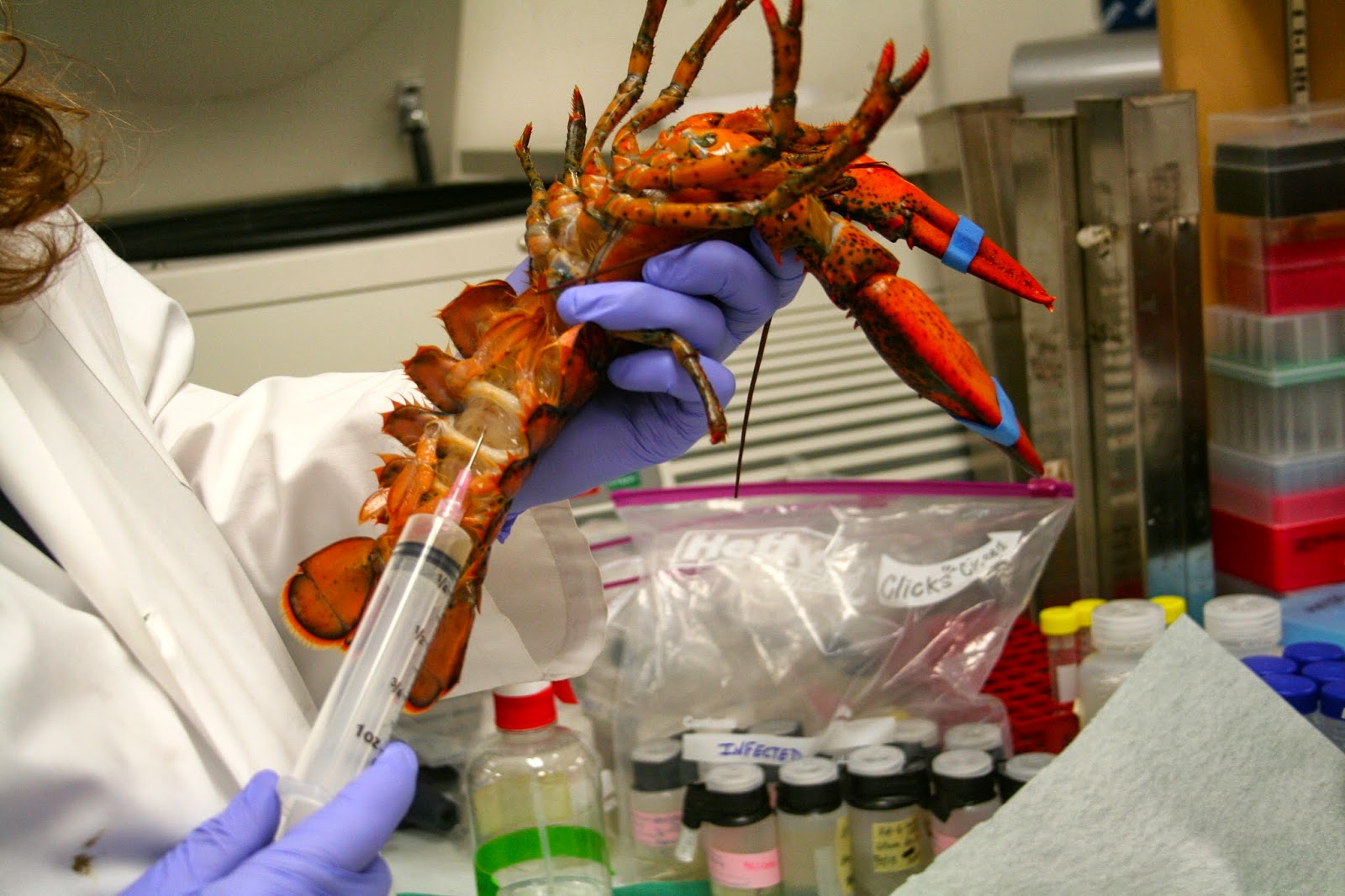
Taking some haemolymph (that's lobster blood).
In other news, the 'science' is going great, I am doing some DNA extractions so I can test some primers, and doing lots of reading. Everyone has been so helpful, and I am actually really excited to go back home and start my experiments, now that I have a solid plan. I am also really excited because I have been in contact with another lobster professor, from Virginia (the last stop of my trip), and we are going to meet and discuss my plans - just so I can have the perspective of another scientist - he might have some additions or changes I could make to my plans, or even just some advice. May seem like overkill, but I just want to make the most out of my time over here... it is, after all, a once in a lifetime experience!

Monday, 19 August 2013

An afterthought...

Clonk and I, pre release, Oxwich bay.
So after my super successful first blog (64 page views in an hour wahoooo), I thought I should explain a little about the title of my blog. Self explanatory, but also a cute story.

During my undergraduate degree, Dr. Emma Wootton, a postdoc in my lab was my 'mentor' (basically she told me what to do and taught me to love all things lobster), and introduced me to a Swansea lobster, which she had named Clonk.

All of the lobsters in our aquarium were either from the Lundy Island MCZ, or born at the Padstow Lobster Hatchery and reared in CSAR, the university's aquaculture facility. The only lobsters that were reported to have the parasites seemed to be the Lundy ones, so to test this theory, Emma got hold of a lobster from the Swansea area and brought him back.

However, it seemed that he didn't want to moult, so we couldn't check him for the parasites (visible on the gills only), and when he did, he did it in the dead of night, usually on a weekend, so that nobody was there to check, and then ate his moult before we arrived on the Monday. Basically, he was a right pain!

At first, Clonk was put in the big tank with all the other wild caught lobsters (banded, of course), but after a few weeks we had to put him in solitary confinement. Not only did he start fights with nearly all of the other lobsters, he stole their food too. Long story short, ASBO lobster was put in his own tank, where he happily munched on mussels by himself, regained his claw power after having his bands taken off, and clonked the side of the tank loudly whenever anyone went into the 'lobster room', because he was an attention seeking little monster.


Foot Clonk.
Naturally, when it came to me getting my first ever tattoo, it had to be a lobster, and who else better than Clonk to be the star of the show? After a drunken discussion with friends one evening about how I should definitely man up, stop talking about getting one, and just get one, I took a photo of my beloved lobster to the tattoo shop and 24 hours later was branded for life (Eek!).

At the end of May, Emma left the university for a career in horticulture, her other passion in life, and we were all very sad to see her go. She agreed that she would miss us too, but mainly the lobsters, as they are much easier to get on with than humans, and it came to my attention that we had been holding onto Clonk a little too long. The parasite experiments were long over, and since we couldn't release the Lundy ones around Swansea, the only one we could release was Clonk. I figured that he was the most aggressive lobster ever, so he would definitely be able to look after himself, and I v-notched him just to be sure he wouldn't end up back in the pot straight away.

As ever the social media fanatic, I decided to document his journey to freedom, along with some friends so that I could show the world, but mainly Emma, his final journey, via youtube ...


As usual.. you can tweet me @_CharlotteEve_, or check me out on LinkedIn.

The life and times of lobster girl...


Okay so I know I've been threatening to start up a blog for quite a while, but this time I really mean it! What is this change of heart in aid of, I hear you ask? Well, I only went and got a travel scholarship didn't I... Clever girl. But first, for those who don't know me... let me introduce myself.

To my friends back home it may seem that I have been partying in Swansea for the last *ahem*.. 6 years, but in amongst all that dancing, beach BBQ-ing and surfing, I managed to obtain a Biology degree (hurrah!) and am now well on my way to getting a PhD and becoming a doctor (Oooh!).

Sampling on a commercial fishing vessel near Devon.
On the other side of things, there are my friends in Swansea, who simply know me as 'Lobster girl.. that girl that does lobster stuff... the one with the lobster tattoo!' No, I am not some sort of magical superhero with giant claws for weapons, but a lobster pathologist looking into all things fatal and disastrous to our beloved European lobster (Homarus gammarus, for you science geeks out there). I am passionate about disease susceptibility, with special reference to impacts of invasive species (yes, I'm talking about you, you pesky Americans). I am also a huge supporter of sustainable fisheries, rather than banning fishing altogether (sorry Hugh)... and am interested in the implementation of MPA's, especially how disease susceptibility might change within conservation areas.

How did I get into this line of work? Well, it's all down to my lovely supervisor, Prof. Andrew Rowley (who never updates his website, it seems), who offered me a lobster project for my dissertation as I neared the end of my bachelors degree, simply for being in his office at the right time, looking at a 'new' parasite that fishermen had been finding on lobsters around a Marine Conservation Zone (MCZ). Naturally, the two modules I had decided against taking that year were Parasitology and Cell and Immunobiology, so as you can see, it started off well. Not.

Lobster research in the UK is limited, the real hub of activity is based at IMR, Norway, whereas American lobster research is a vast area, spanning all over the US and Canada. As I started my PhD my first 'project' was a collaboration with the New England Aquarium in Boston, Massachusetts, where they are nearly as lobster mad as me. It was a match made in heaven.

Some of my baby research subjects. 
At the moment I am back to looking at parasites (should have taken that module...), which is really interesting, and I will keep you updated, but I am also starting up a new collaboration with the AVC Lobster Science Centre, in Canada, this coming fall.

I have been lucky enough to get two travel scholarships, one from the Society of Biology  and one from Climate Change Consortium for Wales (C3W),  and so I commence my travels in September. On top of the trip to Canada I am heading down to NEAQ to tie up some loose ends, and having a cheeky couple of nights in NYC before heading to Virginia to visit my amazing friends Tessa and Rebecca, who interned this summer at our department in Swansea.

I do hope to keep everyone updated with my antics (and frantic preparation, packing and tie-ing up of loose ends here at Swansea), but guaranteed I will forget and you will be reading my next blog at some point in 2015.

In the meantime, you can tweet me @_CharlotteEve_, or check me out on LinkedIn.